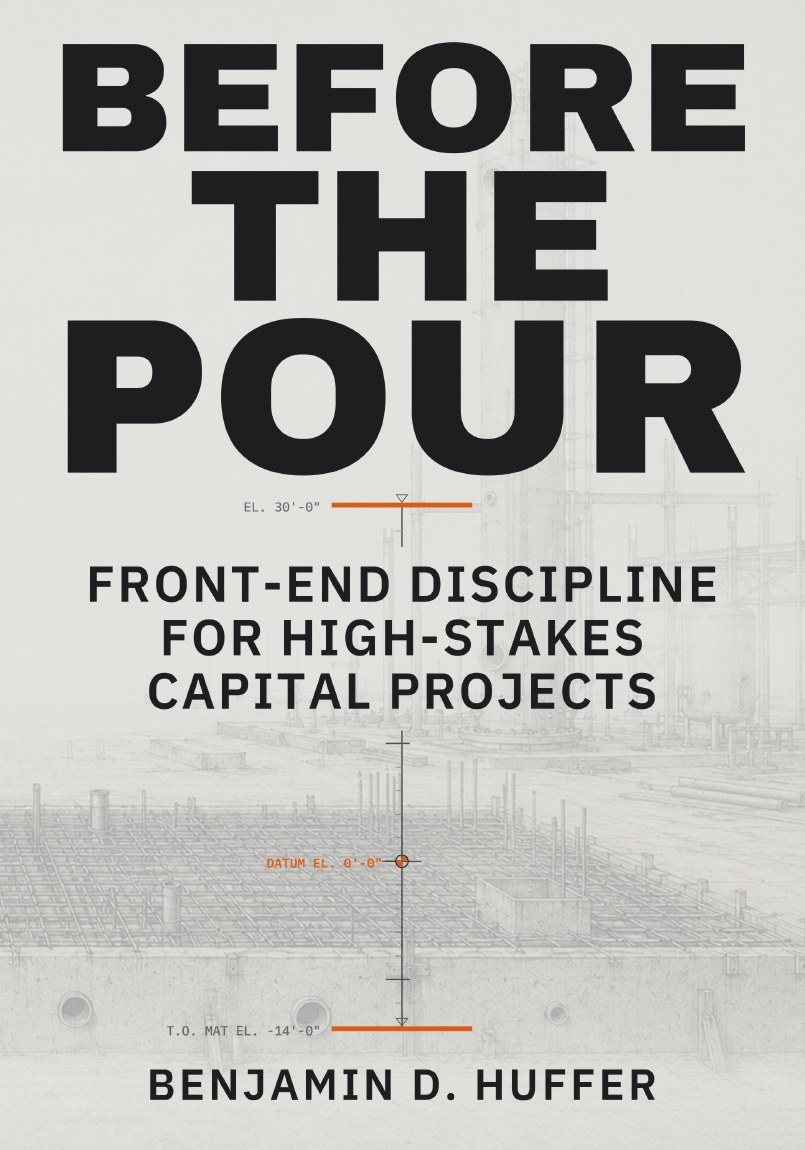
Before the Pour
Front-End Discipline for High-Stakes Capital Projects
The costliest failures on capital projects begin long before construction. The loss is signed politely in a conference room, months before anyone pours concrete.
Front-End Discipline for High-Stakes Capital Projects
The costliest failures on capital projects begin long before construction. The loss is signed politely in a conference room, months before anyone pours concrete.
The Argument
Projects are lost when a weak estimate becomes a promise. When a loose handoff becomes someone else's problem. When a gate review accepts confidence instead of evidence. By the time the concrete truck is idling, the cost may already be committed. It simply has not left the bank yet.
What the field calls a “construction problem” is often a design-definition problem wearing a hard hat.
The field does not get to solve it cheaply. The field gets to pay for it at field rates, on the critical path, in front of everyone.
This book teaches you to find expensive failure while it is still cheap to fix.
Inside the Book
A working manual for the moment before commitment: frameworks for pricing what a project owes, checklists that test evidence instead of optimism, and templates you can put on your project this week.
A framework for naming what a project owes when work depends on answers it has not earned, and for pricing that debt before it compounds.
In every chapter, built to test whether the evidence actually supports the decision, not whether the package looks green.
Practical tools for interfaces, margins, decision rights, contingency, work-front readiness, and the handoff to construction.
One major capital project followed across the book, showing how early decisions compound through its life.
Every chapter ends with three actions you can take on your project this week. Not a pep talk, a work plan.
For anyone who must approve a number, defend a schedule, or sign a gate package they cannot afford to get wrong.
Who It Is For
Owners and project directors. Engineering managers and discipline leads. Project managers, estimators, and construction managers. EPC and EPCM leaders. Independent reviewers and oversight staff. If your name goes on the estimate, the schedule, or the gate package, this book was written for your signature.
The discipline follows the project front end, stage by stage:
Naming the mission, the deferred decisions, and the Definition Debt the project is already carrying.
Interfaces, margins, decision rights, and estimates that can survive being audited.
Gate packages that show their gaps as clearly as their green status, and reviews that test evidence instead of confidence.
Work-front readiness and the handoff to construction, before field rates start running on the critical path.
Before the pour, a change is an eraser and a red pen. After it, a change is a saw cut and a reweld. Before the Pour
About the Author
Benjamin D. Huffer is a chemical and nuclear environmental engineer with over a decade in the DOE and NNSA complex and heavy industrial sectors. He has advised projects up to $20B, worked under DNFSB, NNSA, and NRC oversight, and spent his career at the front end of capital projects, where the cheap decisions and the expensive ones are made, usually long before anyone knows which was which.
He has sat on both sides of the table, writing the estimates and auditing them, issuing the designs and reviewing them. He founded FlyFission Consulting Group to help organizations make technical decisions that can withstand reality.
Ben helped us closeout one stage gate of a $500MM project by working directly with the FPD to author the project Conceptual Design Report and Design Management Plan. He's a good problem solver and solution-oriented.